
At some point, most growing businesses face this decision: build an internal marketing team, or bring in a digital marketing agency in Pakistan. Both can work well, but they suit different stages of business, different budgets, and different appetites for managing people versus managing a vendor relationship.
The honest answer is that neither option is universally better. What matters is understanding the real trade-offs in cost, skill coverage, and flexibility, so the decision fits where your business actually is today rather than where you hope it will be in two years.
The Real Cost of an In-House Team
Salaries are only part of it. Add training, tools and software subscriptions, management overhead, and the time it takes to hire well, and an in-house team often costs more than businesses initially expect, especially for the specialized skills SEO and paid ads require.
There is also the hidden cost of the learning curve. Even a strong hire needs weeks, sometimes months, to fully understand your industry, your customers, and what has and has not worked before. That ramp-up period is paid time with limited output, which rarely shows up in the initial salary comparison.
The Real Cost of an Agency
A monthly retainer covers a full team’s worth of specialized skill without the overhead of salaries, benefits, or software licenses, since the agency spreads those costs across multiple clients rather than billing them entirely to one account.
Agencies also bring pattern recognition from working across many businesses and industries, which an internal hire, however talented, simply has not had the chance to build yet.
Skill Coverage: One Generalist vs a Full Team
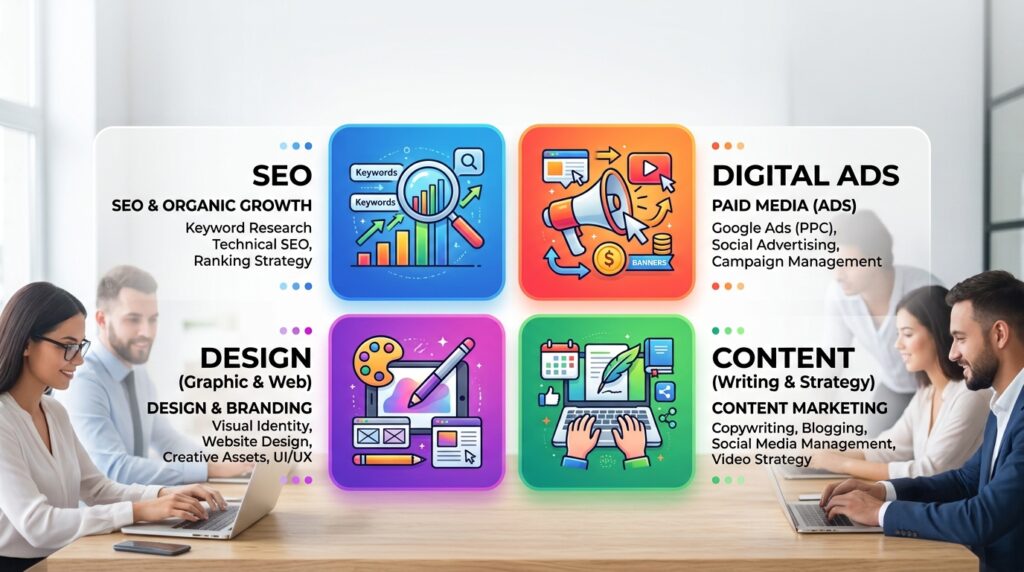
A single in-house marketing hire is rarely an expert in SEO, paid ads, content, and design all at once. A SEO service provider in Pakistan working as an agency brings a full team of specialists to every account, which is difficult to replicate with one or two internal hires on a typical small business budget.
This matters most when a campaign needs several skills working together at once, for example a new landing page that needs design, copywriting, and technical SEO all aligned before a paid campaign can launch properly.
Flexibility and Scaling
Scaling an agency relationship up or down is usually as simple as adjusting the retainer. Scaling an in-house team means hiring, onboarding, or, in tougher periods, layoffs, all of which take time and carry real financial and morale cost.
Seasonal businesses in particular benefit from this flexibility, since ad spend and content output can be dialed up before a busy season and pulled back afterward, without the awkwardness of adjusting a salaried employee’s workload.
When In-House Makes Sense
- You have consistent, large enough budget to support a full specialized team
- Marketing needs deep, ongoing product or industry knowledge
- You want direct day-to-day control over every decision
When an Agency Makes Sense
- You need specialized skills without full-time headcount
- Your needs fluctuate month to month
- You want to start seeing results faster than a hiring process allows
A Hybrid Approach That Often Works Best
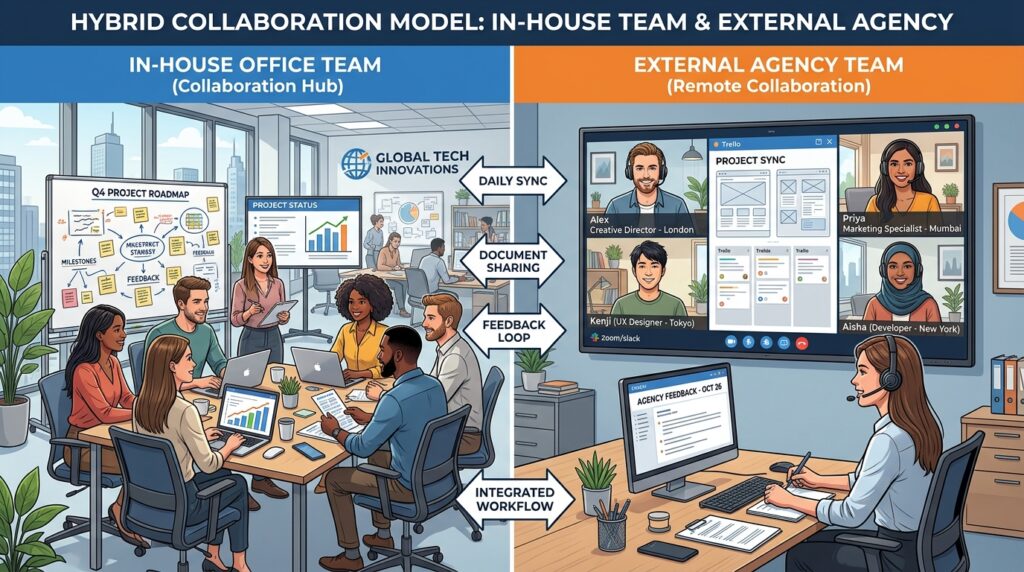
Many growing businesses in Pakistan keep one internal marketing coordinator to manage day-to-day communication and brand consistency, while an outside digital marketing agency Pakistan handles the specialized execution across SEO, ads, and content. This gives you a single internal point of accountability without carrying the full cost of building every specialist role in-house.
Whichever route you choose, revisit the decision periodically rather than treating it as permanent. A business that starts with an agency at PKR 10 million in annual revenue may genuinely be ready to build parts of the function in-house once revenue triples, and the reverse is just as common when priorities shift.
A Quick Cost Example
Consider a mid-sized retail business with three outlets in Lahore. Building an in-house team of an SEO executive, a paid ads manager, and a content writer, even at modest local salaries, plus software subscriptions for keyword research and ad management tools, can easily cross PKR 250,000 a month before any actual ad spend or content production costs are added.
A comparable full-service retainer with a digital marketing agency in Pakistan, covering the same three functions plus web development support, often lands in a similar or lower range while including access to a far broader bench of specialists. This is not to say in-house is always the wrong call, some businesses genuinely need that level of direct control and are large enough to justify it. But running the numbers honestly, including the hidden costs of hiring, training, and turnover, is worth doing before assuming that building a team internally is automatically the cheaper path.
Whether you land on hiring in-house or partnering with an agency, working with an established SEO service provider in Pakistan gives you a real benchmark to compare against as you make the decision, even if you ultimately choose to build part of the function internally.
Frequently Asked Questions
1. Is hiring an agency cheaper than an in-house team?
For most small to mid-sized businesses, yes, since an agency retainer covers a full team of specialists without the overhead costs of salaries, benefits, and software licenses.
2. Can I have both an in-house person and an agency?
Yes, this hybrid model is common. An internal coordinator manages brand and communication while the agency handles specialized execution like SEO and paid ads.
3. How many people does an in-house marketing team really need?
A genuinely full-service in-house team typically needs at least four to five specialists (SEO, content, paid ads, design, and management), which is a significant investment for most small businesses.
4. Does an agency give me a dedicated point of contact?
Most established agencies, including SEOTYT, assign a dedicated account manager as your single point of contact, even though a full team works behind the scenes.
5. What happens if my in-house marketer leaves the company?
You lose momentum and institutional knowledge immediately, and often face a gap of weeks or months while hiring and onboarding a replacement, a risk an agency relationship does not carry.