
International SEO is the work of helping one business rank in more than one country, so that a buyer in Dubai sees your UAE page and a buyer in London sees your UK page. For Pakistani exporters, software companies, textile brands, and service firms, it usually means ranking in the Gulf, the UK, the US, or Australia while keeping a presence at home. Most of the work is structure first and content second.
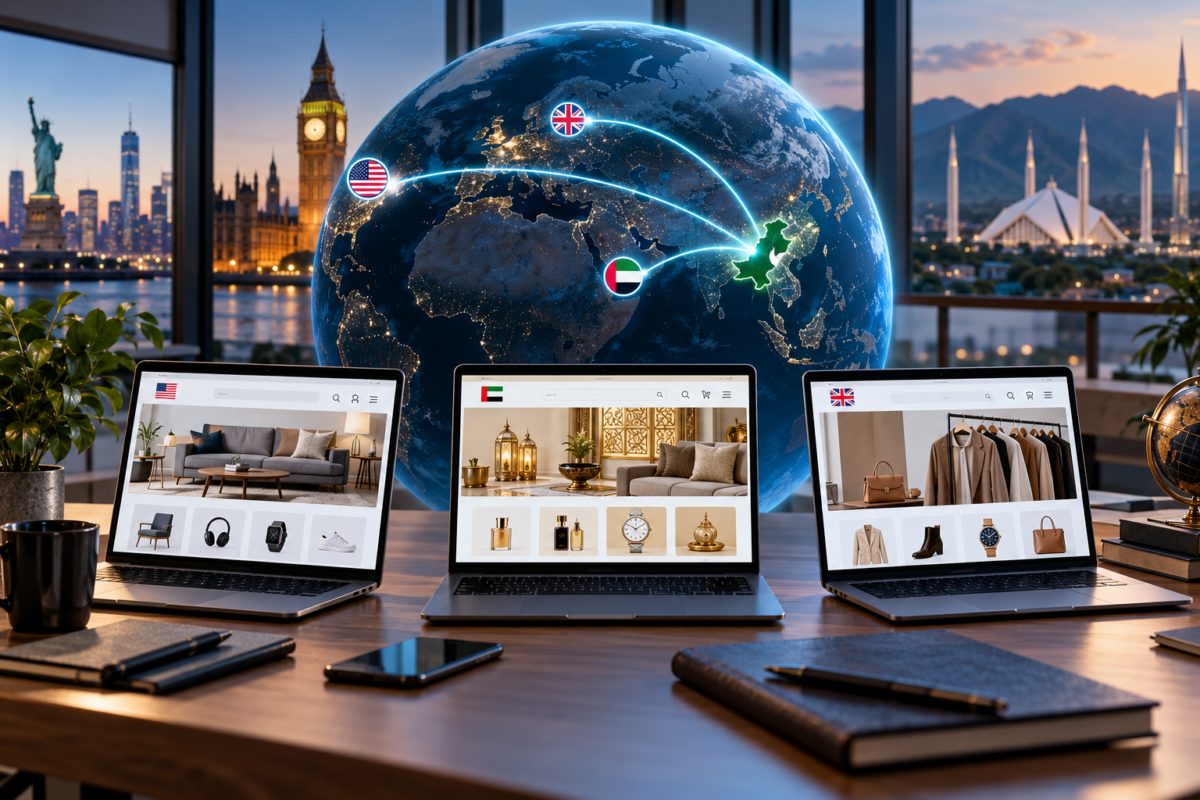
Start by Deciding Who You Are Targeting
There are two kinds of international targeting. Country targeting means separate pages for separate countries, for example a UAE page with AED prices and a UK page with GBP prices. Language targeting means separate languages, such as English and Arabic.
Many Pakistani businesses only need English, but they still need separate country pages, because prices, delivery, taxes, trust signals, and even search terms change from one market to another. The international SEO services Pakistan exporters buy should always start with this decision, not with content.
Choosing a Domain Structure
| Option | How it looks | Usually best for |
|---|---|---|
| Subfolders | yoursite.com/ae/ and yoursite.com/uk/ | Most businesses; all markets share one domain's strength |
| Country domains | yoursite.ae and yoursite.co.uk | Large brands with local teams and budgets |
| Subdomains | ae.yoursite.com | Rarely the best choice for smaller sites |
For most businesses, subfolders on one .com domain are the practical choice. Every link you earn helps all your markets, and you maintain one website instead of several. A .pk domain signals Pakistan to Google, so it is not ideal as the main site for foreign markets. Getting this structure right at the start is as much a job for a web development company in Pakistan as it is for your SEO team, because changing it later means redirects for every page.
Hreflang Tags Tell Google Which Page Is Which
Hreflang tags are short lines of code that tell Google which language and country each page is for. Without them, Google may show your Pakistan page with PKR prices to a buyer in Dubai. Google explains the setup in its own documentation on localised versions of pages.
The rules that trip people up:
- Every version must list every other version, and itself
- Each set should include an x-default page for visitors who match none of the versions
- Country codes must be correct, for example en-GB for the UK, not en-UK
- Hreflang should point to the final URL, not to a page that redirects
Broken hreflang is one of the most common problems on a multi-country website, and it often goes unnoticed because the site still looks fine to visitors.
Content Must Change, Not Just the Currency
Search behaviour differs between markets. A UK buyer might search "bespoke" where a US buyer searches "custom". A UAE buyer may want to know about delivery to Sharjah or VAT invoices. Good international pages adjust:
- Prices, currency, taxes, and delivery or service times
- Spelling and terms for each market
- Trust signals that matter locally, such as company registration or certifications
- Contact options that work across time zones, including WhatsApp

Payments and Trust Matter as Much as Rankings
Ranking abroad only helps if buyers feel safe contacting you. Show accepted payment methods clearly, such as international cards or bank transfer. Add your company registration details, a real office address, and a named contact person. For B2B exporters, a downloadable company profile and certificates such as ISO help overseas buyers justify choosing a supplier they have never met.
Technical Checks Before Launch
- Make sure pages load quickly for visitors abroad, ideally through a CDN.
- Avoid forced redirects based on the visitor's location. They can stop Google from reaching your other versions. Offer a country selector or a suggestion banner instead.
- Include all country versions in your XML sitemap.
- Check that prices, contact numbers, and delivery details on each version are correct before launch, since a wrong currency costs you the enquiry.
Earning Links in Each Market
Links from the country you target carry more weight there. A mention in a UAE business directory or a UK trade association helps your UAE and UK pages more than another Pakistani directory. Most SEO services in Pakistan focus on local search, so check that whoever you hire has worked on foreign markets before. Trade fairs, chambers of commerce, and industry associations abroad are good places to start.
Measure Each Market Separately
Set up each country folder as its own filter or property in Search Console, and compare enquiries by country in GA4. Without this split, growth at home can hide a flat result abroad, and you will not know where the next month of work should go.
Be Patient With New Markets
Your brand may be well known in Pakistan and completely unknown in Manchester or Sharjah. Early months in a new market are about a small number of strong pages, a few genuine local links, and reviews or references from clients in that country. Expect slower progress than you are used to at home. Ask your SEO service provider in Pakistan for quarterly reviews of a new market rather than weekly reports, because the numbers are too small early on to mean much.
Start With One Market
Pick the foreign market that already brings some enquiries, build it properly, and expand once it works. Spreading a small budget across four countries usually leaves all four weak. A digital marketing agency in Pakistan can help you choose that first market from your own enquiry data.
For online stores selling across borders, our ecommerce SEO services in Pakistan cover country pricing, product feeds, and localised product pages. Whoever builds your international setup, ask to see how each market will be structured before work begins. That plan should exist on paper before the first page is written.
Frequently Asked Questions
1. Do I need a separate website for each country?
Usually not. Country subfolders on one domain are easier to manage and let all markets share the same authority.
2. What are hreflang tags?
Hreflang tags tell Google which language and country each page is for, so the right version appears in each market.
3. Can I rank abroad with a .pk domain?
It is harder, because .pk signals Pakistan to Google. A .com with country subfolders is usually the better choice.
4. Should I redirect visitors by country automatically?
Avoid forced redirects. Use a country selector or suggestion banner so both users and Google can reach every version.
5. How long does international SEO take?
Often six months to a year for a new market, depending on competition, because you are building trust where your brand may be unknown.