
A technical SEO audit is a health check of your website from a search engine's point of view. It looks at whether Google can reach your pages, understand them, and load them quickly. It does not judge your writing or your design taste. It finds the hidden problems that stop good pages from ranking.
Many business owners pay for an audit and receive a long PDF they cannot use. This guide explains what a proper audit covers, what the report should contain, and how to tell a useful audit from an automated printout.
Why a Technical Audit Matters
You can publish strong content and still get little traffic if Google cannot crawl or index it. Technical problems are usually invisible to visitors. The site looks fine in a browser, yet half the pages are missing from Google, or several versions of the same page are competing with each other.
An audit matters most at certain moments: before a redesign, after a traffic drop, after moving to a new platform, or when a site has grown for years without anyone checking the foundations.
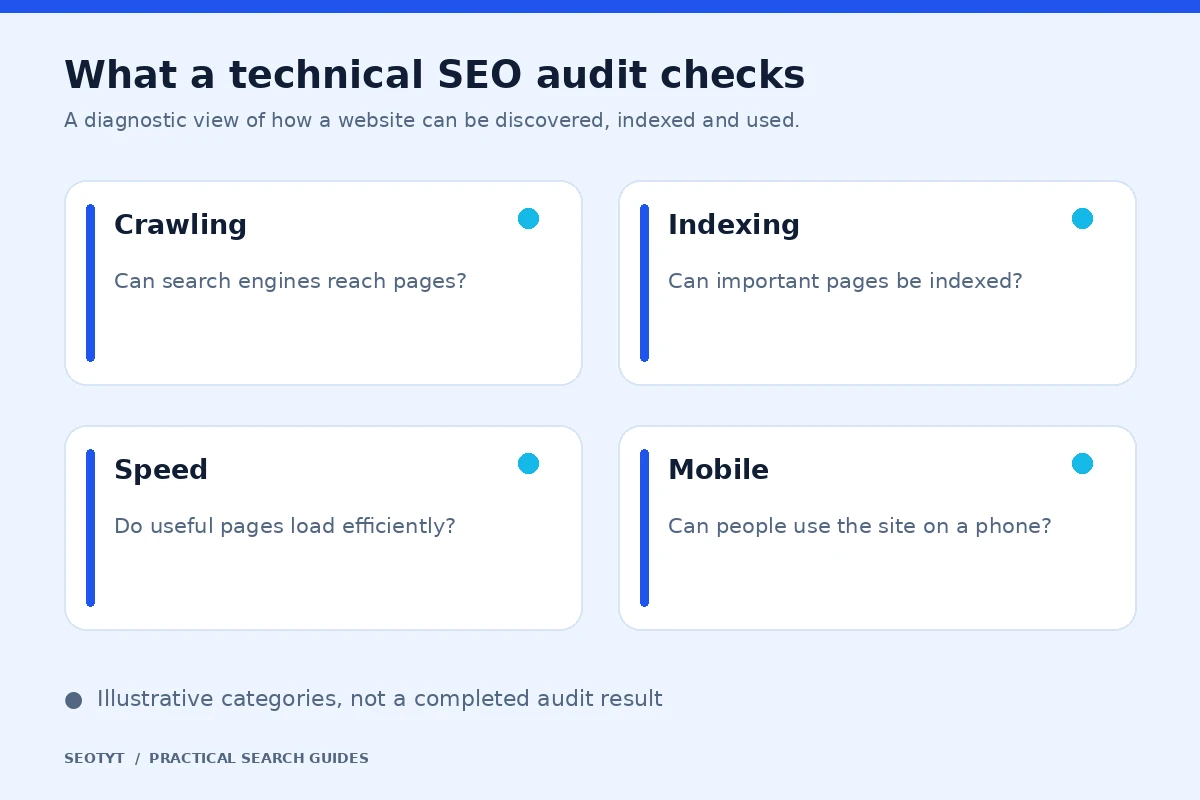
What a Technical SEO Audit Checks
A thorough audit covers these areas. Each one answers a simple question.
- Crawling: can Google reach every important page, or is something blocking it?
- Indexing: which pages are in Google, which are not, and why?
- Site structure: can a visitor and a crawler reach key pages in a few clicks?
- Duplicate content: do several URLs show the same page without a clear main version?
- Redirects and broken links: do old addresses lead somewhere useful or to errors?
- Page speed: how quickly do pages load on a real mobile connection?
- Mobile usability: is everything readable and tappable on a small screen?
- Security: is the whole site on HTTPS with no mixed content warnings?
- Structured data: is the markup valid and does it match what is on the page?
- Sitemaps and robots.txt: are they accurate and pointing Google the right way?
For larger or international sites, an audit may also check language targeting and how the server responds to Google's crawler over time. A business expanding abroad, for example one investing in SEO in Dubai to reach customers in the UAE, needs each country version checked for the right signals.
What the Audit Report Should Include
The value of an audit is in the report. A good one is written for a person who has to decide what to fix first, not for another SEO specialist.
- A short summary in plain language of the three to five biggest problems
- Each issue explained: what it is, why it matters, and how many pages it affects
- Example URLs for every issue, so your developer can see the problem directly
- A priority level for each fix, based on impact and effort
- Clear instructions on how to fix it, or who needs to
- A note on what was checked and found to be fine
That last point is often missing. Knowing what is healthy saves you from paying someone to "fix" things that were never broken. Reports like this are a normal part of SEO services in Pakistan, and the priority list is usually what shapes the first three months of work.
A Tool Report Is Not an Audit
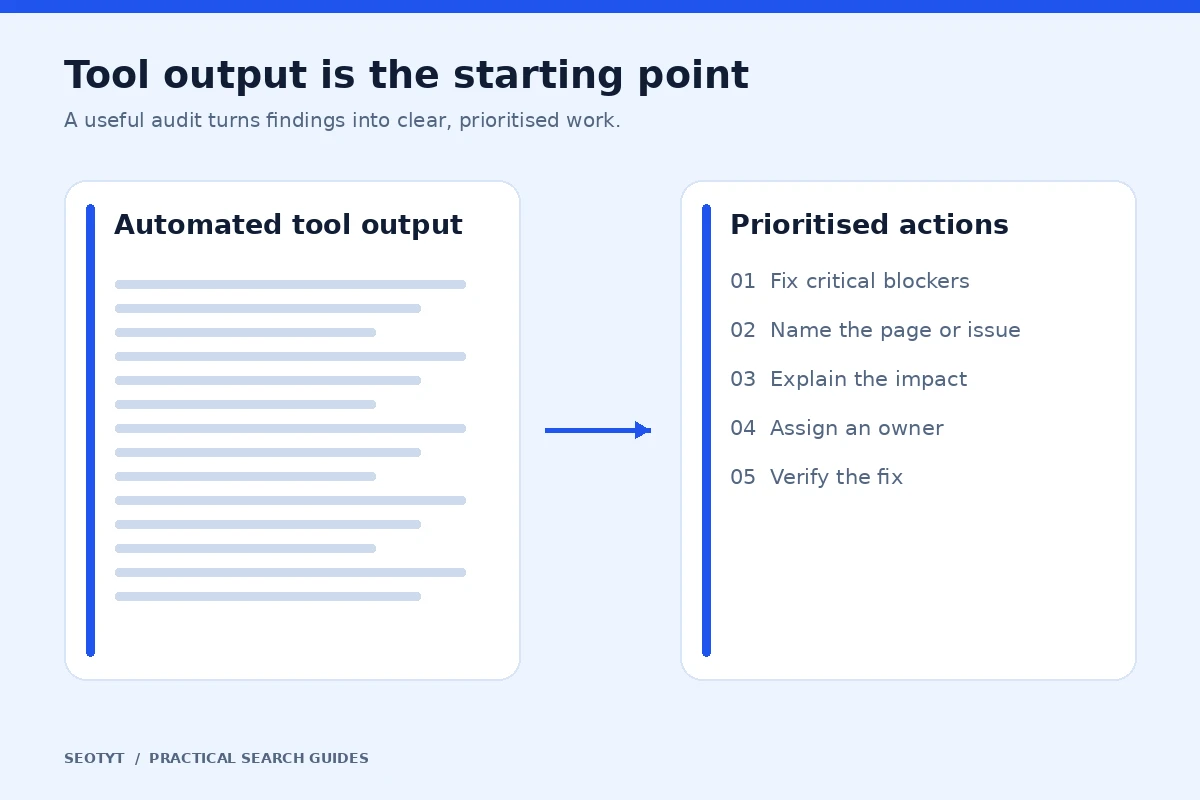
Free and paid tools can crawl a site and produce a score with hundreds of warnings. These are useful starting points, but they are not an audit. A tool cannot tell which warnings matter for your business. It will flag a missing description on a privacy policy page with the same urgency as a noindex tag on your main service page.
A real audit involves a person reading the data, checking Search Console, looking at how your pages appear in Google, and deciding what is worth your developer's time. Ten issues in the right order are worth more than three hundred in a spreadsheet.
How Long It Takes and How Often You Need One
A small business site of a few dozen pages can be audited in a few days. A large store with thousands of products takes longer because there are more templates and more ways for things to go wrong. Be wary of anyone promising a full audit in an hour.
Most sites benefit from a full audit once a year, plus a lighter check after any major change. If your traffic fell after a Google update, an audit is a sensible first step alongside a core update recovery review, since technical faults and content issues often show up together.
Red Flags When Buying an Audit
- The provider does not ask for Search Console access
- The sample report is only a tool export with a logo on it
- Every issue is marked as critical
- There are no example URLs
- The audit is "free" but the fixes are only available in an expensive package
A free audit is not always a trick. Many agencies offer a short review to start a conversation. Just understand the difference between a quick review and a full audit, and ask which one you are getting. A reliable SEO service provider in Pakistan will tell you plainly.
What Happens After the Audit
An audit fixes nothing by itself. Its job is to give you an ordered list. Some items your developer can fix in an afternoon, such as a wrong robots.txt rule. Others, such as restructuring categories, need planning. Ask for a short follow-up check once the fixes are done, to confirm they worked.
If you work with a digital marketing agency in Pakistan, the audit should feed directly into the monthly plan and not sit in a folder. To see how audits and fixes are scheduled at different budget levels, have a look at our SEO packages in Pakistan.
Frequently Asked Questions
What is a technical SEO audit?
It is a review of how well search engines can crawl, index, and load your website. It finds hidden problems such as blocked pages, duplicates, slow loading, and broken redirects.
How is a technical audit different from a content audit?
A technical audit checks the site's foundations, such as crawling, indexing, and speed. A content audit reviews the quality and relevance of what is written on the pages.
How long does a technical SEO audit take?
A small site can take a few days. Large stores or sites with thousands of pages take longer because there are more templates and page types to review.
Are free SEO audit tools enough?
They are a useful starting point but cannot judge which issues matter for your business. A proper audit needs a person to review the data and set priorities.
How often should a website be audited?
Once a year suits most sites, with a lighter check after a redesign, a platform change, a hosting move, or a sudden drop in traffic.